From Pressed Felt to the Familiar Tennis Ball
Learn how a tennis ball’s felt and rubber core work together, and how to read their wear when choosing a ball for your court and playing session.
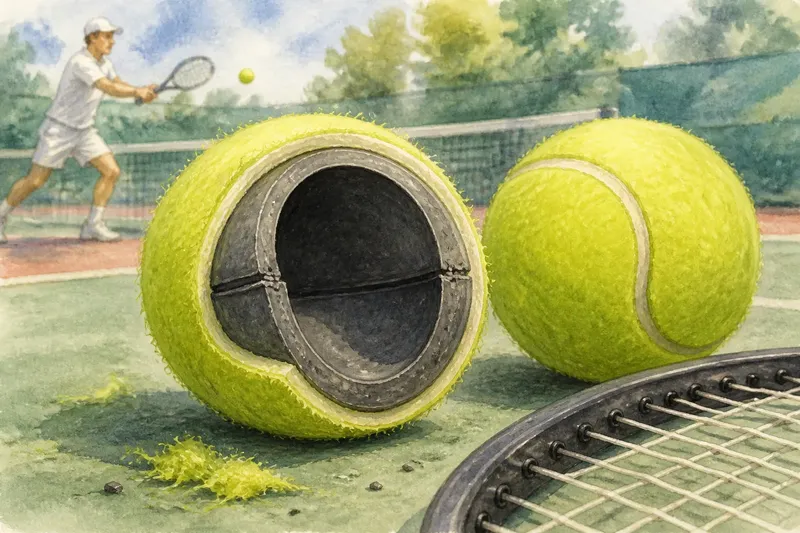
Why does a tennis ball need both a rubber core and a felt cover? The core deforms and rebounds on impact, while the cover shapes contact with air, racket strings and court. The familiar tennis ball developed through changes to both layers, rather than one material breakthrough.
The modern ball combines rubber and textile
A standard pressurised tennis ball has a hollow rubber shell beneath a textile covering. The shell changes shape when the ball hits a racket or court, then springs back. The felt-like outer layer protects the rubber and influences how the ball moves through the air and across a surface.
Think of the core as a spring inside a woollen coat. The spring supplies much of the rebound; the coat changes how the object meets its surroundings. The analogy is imperfect, but it explains why the cover is functional rather than decorative.
Many tennis balls have a two-piece rubber shell joined around its middle. The outer textile commonly blends wool and synthetic fibres, though materials and construction vary. Manufacturers shape and bond the covering to the shell, then finish its raised nap. Players often call this surface felt, even though it is generally a textile rather than traditional felt cloth.
Earlier balls reflected the materials available
Early tennis balls were made from materials including cloth, hair, wool and other packed fillings. Makers stitched or wrapped coverings around the centre, and the finished balls were less uniform than a sealed rubber shell.
The wider use of rubber changed the ball’s response. A resilient rubber centre could deform and recover more consistently than a loosely packed filling. As rubber processing and ball-making methods developed, makers could form hollow shells and contain pressure within them. This helped establish the lively rebound associated with modern tennis balls.
The covering remained important. A bare rubber ball would interact differently with air, strings and court grit. Textile gave makers another way to shape flight and wear, while providing a consistent exterior for play.
The rubber core contributes to rebound
On impact, the core briefly changes shape. Some energy becomes heat and sound, while the rubber returns some stored energy as the ball rebounds. In a pressurised ball, the air inside also affects how the shell responds. The result depends on the rubber, pressure, condition and force and angle of impact.
Two new balls can feel different despite belonging to the same broad category. Shell formulation, pressure and production tolerances can all affect response. With use, repeated impacts and gradual pressure loss change how a ball compresses and rebounds. Touch alone may not reveal the cause, because the cover also changes during play.
If an older ball feels less lively than a fresh one and looks flatter, do not assume that pressure loss is the only cause. Rubber fatigue, surface wear and storage may also contribute to the difference.
The felt shapes contact and flight
The covering gives a ball a textured surface. Its fibres create drag as the ball moves through air, affecting its speed and flight compared with a smooth object of the same shape. The nap also influences contact with racket strings and court materials, affecting feel, spin and the way the ball picks up surface dust.
During play, the cover is compressed and rubbed against strings and court. Its fibres may become matted, scuffed or dirty. A worn cover can feel thinner or rougher, and its aerodynamic behaviour can change. The shell underneath may still hold pressure, so appearance and rebound do not always tell the same story.
Some balls have coverings designed for more abrasive courts; others suit different conditions. Check the product label, manufacturer’s instructions and relevant competition rules before choosing a ball for organised play.
What should you check before choosing a ball?
Why does a new ball feel livelier?
A new pressurised ball generally has a more responsive shell and an intact covering. Use can reduce internal pressure and alter the rubber, while the felt wears down. These changes combine, so the difference is not simply a matter of pressure.
Does thicker felt always make a better ball?
No cover suits every court or player. A more durable covering may help on a rough surface, while another construction may feel preferable elsewhere. Read the product description and consider the conditions rather than treating a thicker nap as an automatic improvement.
Can worn felt make a ball seem slower?
The surface affects drag through the air and friction at contact. But perceived pace also depends on the core, court, incoming shot and timing. Felt is one part of the interaction, not a stand-alone speed control.
How do pressurised and pressureless balls differ?
Pressurised balls rely on internal pressure as well as rubber resilience for their familiar response. Pressureless balls depend more on their rubber construction, and their feel can differ from the start. Choose according to intended use and manufacturer guidance; the two types are not interchangeable in every playing situation.
Match the ball to the court and session
Start with the court surface and the session’s purpose. Then check the product description and the condition of both layers. For organised play, confirm any competition requirements before buying. If consistent response matters, compare a questionable ball with a fresh ball of the same type, rather than relying on colour alone.
- Check whether the label names the intended court conditions; if it does, use it as a selection guide, but if it does not, consult the manufacturer’s guidance before buying for organised play.
- Check the cover for torn or badly matted fibres; if either is present and predictable response matters, set the ball aside, but if the cover is intact, assess its rebound as well.
- Check whether a ball feels less lively than a fresh ball of the same type; if it does, reserve it for casual hitting or retire it from a match basket, but if it feels comparable, keep it in the intended group.
- Check whether the ball is pressurised or pressureless; if it does not match the session’s needs, choose the other type, but if it does, follow the manufacturer’s intended-use guidance.
- Check whether loose balls have been stored in conditions that could harm rubber or textile; if they have, inspect their cover and rebound before use, but if storage has been suitable, keep them with balls of similar condition.
- Check whether competition rules specify an approved ball; if they do, select a compliant product, but if they do not, choose by court, session purpose and manufacturer guidance.
Say a club has a rough outdoor court, a fresh can of balls labelled for that surface and a basket of loose balls with unknown age. The organiser checks the event rules, confirms that the labelled balls are permitted, and opens the fresh can for the match basket. The loose balls have matted covers and feel less lively beside the fresh ones, so the organiser moves them to casual practice. The observable result is a match basket with a consistent type and condition; the trade-off is that the older balls remain available for less demanding hitting.
Read the core and cover as separate clues
When a tennis ball feels wrong, inspect the court suitability, cover and rebound separately. Dirt can darken felt, while a clean-looking ball may still have lost some liveliness. Store unopened cans as directed and avoid leaving loose balls in conditions that may damage rubber or textile.
The shift from packed fillings to the modern pressurised shell explains why the ball’s familiar character comes from a partnership of materials. The core supplies much of the spring; the felt moderates contact with air, strings and court. Keep that distinction in mind when choosing tennis balls: either layer can change the feel, and checking both helps you decide whether a ball belongs in a match basket or a casual practice set.